
Floating LED strips still crack

The light strip inside our pole can slide instead of stretching with the tube. That sounds like a solution to fatigue. Then we asked what happens when someone grips the pole in two places. The answer changed the question we need to test.
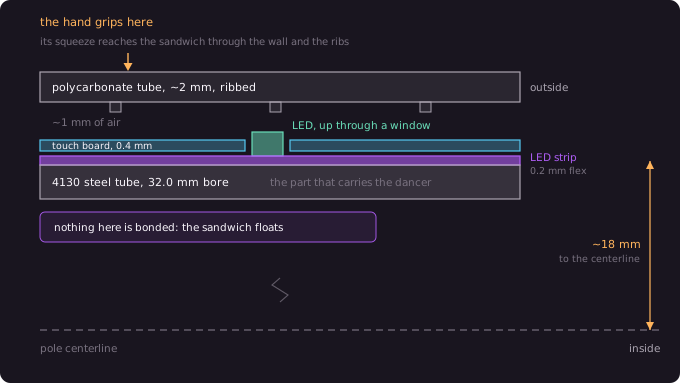
The LEDs in a PoleFX pole live on a flexible circuit between a steel core and a clear outer tube. We did not glue that circuit along its length. The idea was simple: if the pole bends, a free strip can move a little instead of taking the full stretch on the outside of the bend.
Returned strips had cracks near the region where people grip and the pole bends most. We have observations, not a systematic failure count. Our first explanation was therefore a hypothesis, not a diagnosis: perhaps the supposedly floating strip stops floating during use.
What a hand changes
Two grips can press the outer tube onto the layers inside it. If friction holds the circuit at both hands, the span between them must accommodate the bend even though neither end of the full strip is glued down. In a simplified beam model, a 2 in (51 mm) bow asks the strip for roughly 0.07 in (1.8 mm) of extra path length over the 10 ft (3.05 m) run. The amount is small on a ruler and large for thin copper that sees the bend repeatedly.
The analysis suggested a striking result: an ideally free strip sees far less axial strain than a strip fixed at both ends, but a two-hand grip around the bend can give the local span almost the strain of a bonded strip. That result depends on assumed stiffness, contact pressure and friction. We have not measured enough of those inputs to declare grip clamping the cause of the field cracks.
There is a second half to every turn. When the bent strip moves to the inside of the curve, surplus length has to go somewhere. If it cannot slide away, it wrinkles. A tight channel can force that wrinkle into a sharp fold, perhaps near an LED window or solder joint. A channel that looks reassuringly snug may give the circuit less room to survive compression.
A useful prediction
These mechanisms point to different evidence. Grip-driven bending damage should follow hand position and bend. Heating from current should concentrate toward the electrical feed, where the upstream joints carry more of the downstream load. A returned strip with mapped crack positions can help separate the two. A strip that still lights is not necessarily intact: the LED data path may hide some electrical damage, and we have not verified that masking behavior on every custom flex revision.
The next bench test is deliberately plain. Measure the pull force of the assembled strip while a real grip loads the tube. Measure end movement while the pole bends and rotates. Then compare otherwise identical assemblies with one changed constraint at a time. Returned units need photographed crack locations and electrical continuity checks before repair.
The design lesson is that floating describes an assembly under a particular load. It is not a permanent property of a loose part. We can make a better strip only after checking what actually pins it down in use.